
IoT History
Successful Endeavours’ first IoT project, was in 1998. That is before Kevin Ashton used the term “Internet of Things” in a 1999 Procter & Gamble presentation. The trend was already establishing itself and the name stuck.
What did an IoT project look like in 1998?
This was a project with multiple vendors providing monitoring, tracking and telemetry for container movement traceability and vehicle condition monitoring at container terminals. Telstra Mobile Data radios connected the vehicle mounted telemetry to a Windows server via the Internet with vehicle condition monitoring alerts sent to the port management system. Vehicle position used commercial correction licensed GPS to get 0.5m accuracy allowing the port container map in systems like NAVIS to be kept correct, even when a driver made an error in what box was moved to where. And when you handle 400,000 boxes a year it doesn’t take a very high move error rate to lose a lot of boxes and have to send people driving around the container stacks looking for them manually.
Prior to that and for the next decade and a half we stayed out of web services preferring to stick to our field hardware specialty skillset and working with web and App developers.
2013 was the year of change
Speed forward to 2013 and we have a client who needs an Internet connected bulk water management product but it is remote, solar powered, energy intensive in operation and connects to a web service. Except the hardware is not truck driver proof, runs Windows CE so is slow to boot, is not reliable and the existing developer doesn’t want to fix that as there isn’t enough business for them and it wasn’t a good fit anyway. But they are OK with providing the web service. So they handball to us for the field hardware.
We redesign the hardware based on a dual MCU asymmetric multiprocessor design with one doing power management and system wake and the other managing transactions and communications. We select a cellular modem for communications. Cellular modems come with IP stacks. Except their performance in 2013 wasn’t what we needed. We then wrote our own HTTP module. And begin testing communications to the existing back end. Which is when that also proves to not be what is needed and the original developer exits completely.
Our client pivots to a web developer with a proven track record and we develop APIs with them. Security is kept manageable as we are not running a full computing platform here. Hardware is built and ready to ship. The web platform is not. So we throw together a simple version of our own to get by and this includes transactions, configuration control and updates, and firmware over the air updates. These things are installed in places like rural NSW and we don’t want to visit them personally or require others to do so for updates. Which proves to be a good move when a unit installed in Gilgandra has the wrong water meter fitted and the Litres per pulse setting is wrong. 892Km from our office as the crow flies but 5 minutes to fix remotely.
Our client is getting by with us pulling transactions records each month and doing service management under a service level agreement. The client bills their clients based on the records we produce. This is a monthly touch point so manageable while the real platform is being built.
Speed forward 18 months and the real platform is still not ready for deployment. So the incumbent platform we threw together becomes the permanent solution. Which is the start of a trend and brings us to 2015. We named our solution Telemetry Host.
2015 is the IoT takeoff
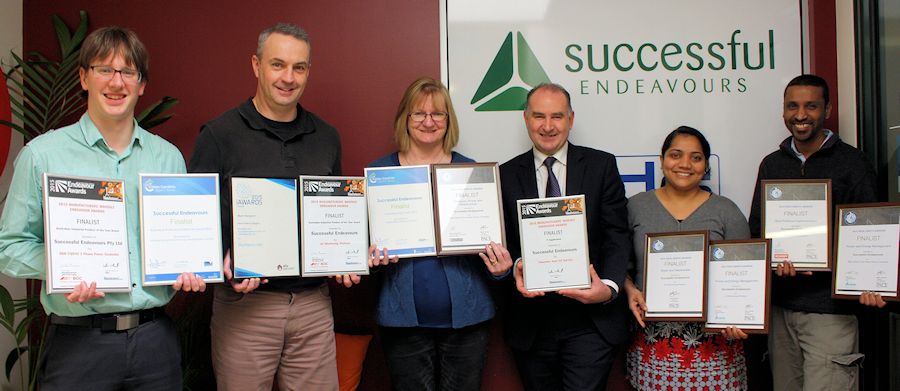
IoT is the first overhyped revolution that turns out to be not overhyped. Device deployment escalates. We win or are finalists for 16 IoT related awards including Telemetry Host. Nearly every project involves IoT in some form. Our HTTP stack remains in place because it is still a good solution and removes device IP stack variability from design risk management. Below are a few of the awards.
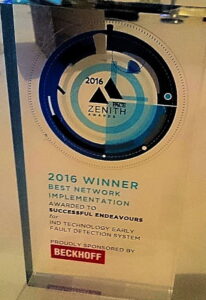
And 2016 sees us win Best Networking Implementation at the PACE ZENITH Awards.
The PACE ZENITH award was for a project that included web services and we are now mostly doing what I called the IoT Technical Plumbing for field operated devices; mobile and stationary. Increasingly clients are finding web and App developers don’t always know how to handle device communications like BLE on mobile phones or Internet connectivity with battery operated devices that aren’t always online. Or it might be dependent on one key developer and when they move on it all falls apart. So we are more often the web developers now and in some cases doing simple Apps to support development because we can’t test without the App and the App is often running late.
So this is the first inflection point. The Internet of Things Drives Economic Growth covers the hype which was subsequently exceeded. Since then we have 2 more inflection points that I consider to be especially significant.
IoT from 2019 to 2025
IoT is now mainstream. Our first BLE to mobile phone project is 2014 but by 2019 it is often expected. IP Protocol Stacks in cellular and WIFI modules are now mature enough to use out of the box and security is starting to become a priority. “Security by Obscurity” has been workable for niche services but now standards based security is required. We retire our beloved HTTP stack as it has done its job and the problem it solved is no longer a limitation.
Technical tip: retire technical debt once the mainstream solutions are equal or better. After this point the debt increases but the value does not.
2019 also sees us win ICT Business of the Year for Australia.
So the period from 2019 to 2025 sees most projects involve IoT somewhere, BLE to phone App is the norm and we are now doing Apps using Flutter, a cross platform App development environment. And production ATE systems not only test devices and serialise but sometimes provision them to cloud services so when they are sold they deployed automatically.
And cloud is now the norm. Our 1998 project with a lone Windows server on premises is a distant memory.
Iot in 2026
It started a couple of years ago, but Ai now dominates everything we touch including finding and exploiting vulnerabilities. There is no “Security by Obscurity” because you can’t obscure. If someone wants to look they can, and comprehensively. Our custom 32 bit encryption for small systems where the unit tests run overnight is no longer safe enough. It made deploying devices to the field able to run for 15 years off D sized primary cells with low power MCUs but new MCUs come with the encryption peripherals to handle that. Even standards based security is in danger. Devices need Trust Zone management. Once code is provisioned to a device you can’t debug it so managing development environments is becoming more technical as is Continuous Integration and Continuous Development (CI/CD) pipelines. Key management and signing are standard problems rather than for high security applications.
The whole world is now on this step change in security and risk management and it gets harder to deploy devices that are both low power and high security. So this is a work in progress for modern development. Clients still have products in the field that we designed in 1998 so when to retire them and upgrade is now a front and centre decision.
This also affects SCADA and IoT as traditionally SCADA has operated inside the protected environment whereas IoT has operated outside it. And increasingly both are part of the same operation. Which also explains the rise of VPN protected SIM plans for IoT connectivity over cellular.
You can see hints of where all of this will go by looking at medical device patient information management, personal information and privacy management, minimum device standards with legal implications for not meeting them – yes you can be prosecuted for deploying an insufficiently secure device now – and we can expect the bar to keep rising. And IoT is in everything and so ceases to be a differentiating feature today.
How do you keep track of what is required?
I have been a member of the IoT Alliance of Australia since 2016. The organisation has recently rebranded as the Connected Technology Alliance, reflecting the ubiquity of connectivity in modern products. And remain a member because this work matters.
Part of the Alliance’s work has included guidance for the Australian Government on connected devices, along with practical guides for manufacturers and users. If you want to understand what is expected from a modern communicating device, these guides are useful starting points:
- Security by Design for Device Manufacturers
- Security Standards for Smart Devices
- Tips for Securing your IoT Device

There is also a new labelling scheme launched at this years IoT Impact event. This is currently voluntary and was developed over the past year by the Connected Technology Alliance and I was in some of the design and review sessions though not a part of the core team driving the process. This is important and ongoing work.
If you take only one thing away from this, it is that IoT security is already a critical requirement. It will only become more important as our connected world looks for the right balance between convenience, safety, privacy, resilience, and security.
Examples of IoT and Connected Product Development
I thought it would be useful to give examples of product types we have worked on since our founding in 1997 where connectivity, telemetry, remote monitoring, embedded software, or IoT formed part of the design and value proposition:
- container location tracking at container terminals
- transport equipment condition monitoring, including location, shock, impact, fuel and tyre pressure
- driver authentication systems
- bulk water tanker refilling and Waterbook water management
- Telemetry Host IoT back-end services
- trade waste type and volume monitoring, including Waterbook Waste back-end support
- arcHUB air quality monitoring and telemetry back end for PM2.5, PM10, wind, sunlight, street light, temperature, CO, H2S, SO2, NO2 and humidity
- people counting
- NB-IoT / CAT-M1 pulse water meter loggers
- Wirepas mesh-networked pulse water meter loggers with CAT-M1 gateways and WaterLink back end
- 915MHz Zigbee Pro mesh-networked water metering
- Plumb Guard electrical safety for plumbers with web logging
- scent management for commercial building air conditioning
- household appliance field-trial monitoring
- battery-operated, portable touch kiosks
- key management systems for car dealers and real estate agents
- high-voltage power factor correction controllers
- water authority general monitoring devices covering pulse counting, flow direction, movement, pressure, wind and cathodic voltage
- automated ute roll-top covers
- remote temperature monitoring
- pool water level management
- pool water quality management
- weight measurement for agricultural produce collection and fertiliser dispensing
- waste bin and compactor monitoring
- agricultural monitoring for water troughs, water level and milk level
- solar rooftop power sharing for multi-tenancy buildings
- emulated altitude training for athletes
- early fault detection systems for electrical distribution grids
- crane load monitoring
- automatic light level management with occupancy monitoring
- pallet tracking systems
- VMS signs
- water quality monitoring
- circular economy packaging reuse dispensers
- water level via pressure monitoring
- machine cycle monitoring
- child BLE tethering and tracking in public spaces to help prevent lost children
- resident tracking in residential care facilities
- pet management systems for unattended indoor dogs
- drift racing path tracking
- airport tarmac debris removal
- remote power monitoring
- local SIM to SIP overseas call systems to avoid global roaming charges
- remote pump monitoring and management
- feral animal traps
For many of these categories, there were multiple products for different clients. This list is not intended to identify individual client projects. It is intended to show the breadth of connected products, telemetry systems, monitoring devices, and IoT-style systems we have worked on over the past 28 years.
Successful Endeavours specialise in Electronics Product Development and Embedded Software and IoT, focusing on products that are intended to be profitably Made In Australia. Ray Keefe has developed market leading electronics products in Australia for more than 40 years.
You can also follow us on LinkedIn and Facebook.
This post is Copyright © 2026 Successful Endeavours Pty Ltd
Leave a Reply